
A book for anyone who’s ever built, broken, or belonged to a product team.


A book for anyone who’s ever built, broken, or belonged to a product team.

A book for anyone who’s ever built, broken, or belonged to a product team.

This book wont teach you how to optimize workflow or scale your sprint velocity. But it will help you see the real reasons products go sideways, and what it actually takes to build something that works. 


Together. No fluff. No blame. Just clarity, candor, and a way forward.

This book wont teach you how to optimize workflow or scale your sprint velocity. But it will help you see the real reasons products go sideways, and what it actually takes to build something that works. 


Together. No fluff. No blame. Just clarity, candor, and a way forward.


Most products don’t fail because people hated them. They fail because teams couldn’t align, because the business model was weak, or because the strategy was never clear. It’s Not Always About the Users takes a hard look at the real reasons good ideas don’t make it, and why focusing only on the “user-first” mindset can be dangerous.

This book pulls back the curtain on the messy reality of product building. You’ll see what really happens when designers and developers clash, when founders chase shiny trends, or when teams lose sight of the bigger picture. It’s a call for honesty, reflection, and a better way of working together.


With practical tools, sharp insights, and lessons from real product journeys, this book helps you connect the dots between users, business goals, and team dynamics. Because building something great has never been just about the user.

Most products don’t fail because people hated them. They fail because teams couldn’t align, because the business model was weak, or because the strategy was never clear. It’s Not Always About the Users takes a hard look at the real reasons good ideas don’t make it, and why focusing only on the “user-first” mindset can be dangerous.

This book pulls back the curtain on the messy reality of product building. You’ll see what really happens when designers and developers clash, when founders chase shiny trends, or when teams lose sight of the bigger picture. It’s a call for honesty, reflection, and a better way of working together.


With practical tools, sharp insights, and lessons from real product journeys, this book helps you connect the dots between users, business goals, and team dynamics. Because building something great has never been just about the user.

Chapters

Introduction: The Most Organized Chaos

Who is this book for? • Product builders who feel something is missing • Teams caught in the blame game • Leaders searching for clarity • Anyone tired of hearing “just focus on the user” • A guide to see the bigger picture • Practical tools, sharp insights, and real stories • How to read this book

Read the introduction for free >

Part 1 - Users, Ego & Data 
1

Awakening to the Great ‘User–Centric Design’ Lie 

We’ve been told that putting users first is the only way to win. The truth is more complicated. Products don’t collapse because people dislike them. They collapse because teams ignore the business, the system, or each other. This chapter unmasks the myth of “user-first” and explains why it’s not enough on its own.

Walk away with a clearer lens on why products fail, how to escape the “user-first” trap, and what a more complete view of product success looks like.

Read the introduction for free >

2

The Assumption Trap 

Assumptions sneak in quietly and wreck everything. Teams assume what customers want, what technology can handle, and what “success” really means. This chapter shines a light on the cost of unchecked assumptions and how to stop them before they undo all your work.

Discover how to spot hidden assumptions early, test them before they harden, and build with evidence instead of wishful thinking.

Read the introduction for free >

Part 2 - The Stakeholders & Their Battles 
3

The Stakeholders 

Behind every roadmap sits a cast of powerful voices—executives, sales, marketing, engineers, and yes, the users. This chapter unpacks how stakeholders shape products, sometimes for the better and often for the worse.

Gain the skills to navigate competing agendas, manage expectations, and keep your product from being pulled apart by too many hands.

4

Designers vs. Developers The Never-Ending Battle 

Design seeks clarity and craft. Engineering seeks speed and stability. Tension is normal. Waste is optional. This chapter turns that friction into forward motion.

Learn how to bridge this divide, turn friction into fuel, and create an environment where design and engineering push each other forward rather than apart.

5

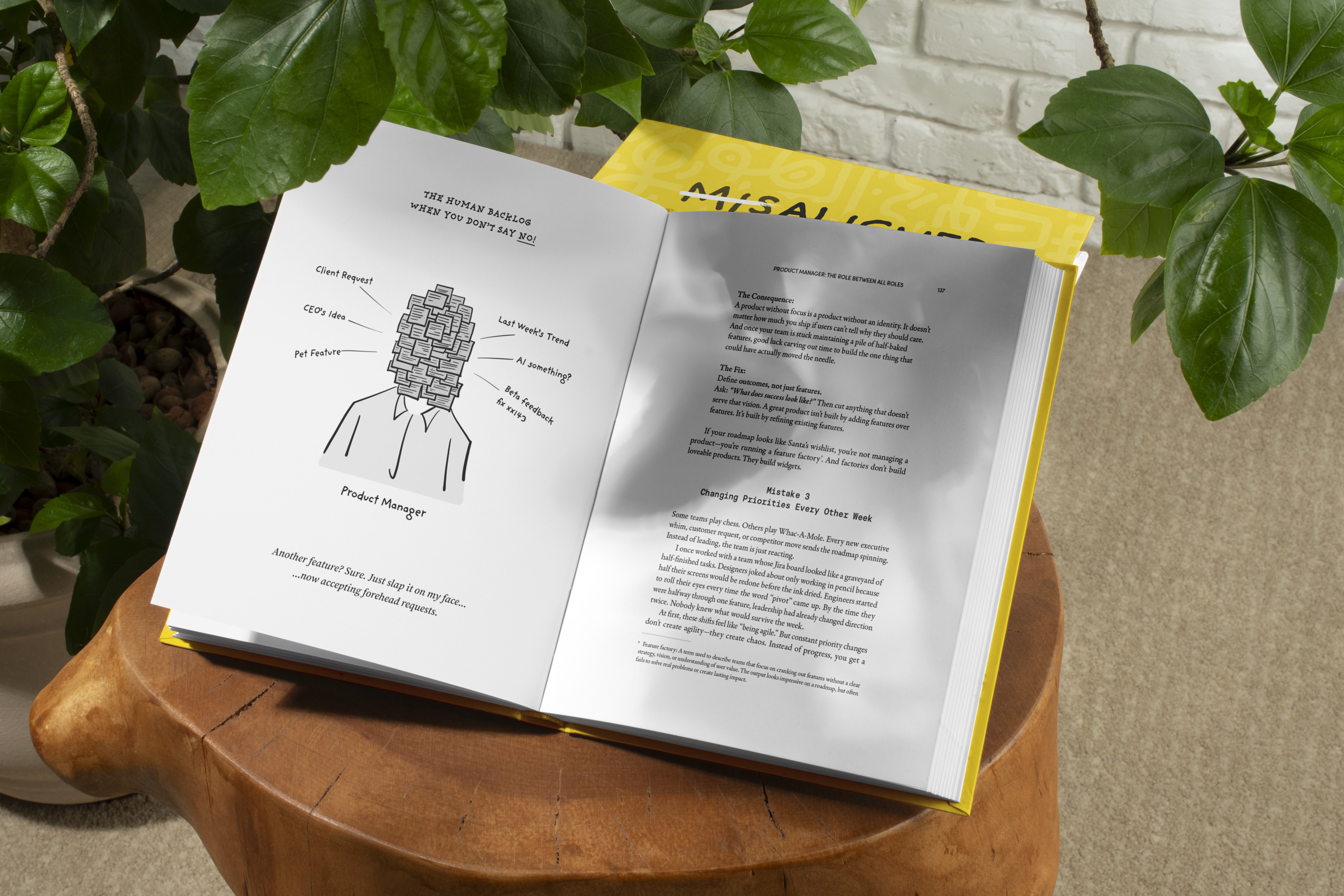
Product Manager: The Role Between All Roles 

The PM is often blamed for everything and praised for nothing. This chapter digs into the misunderstood role of the PM, how they juggle competing agendas, and why great PMs act less like bosses and more like translators, mediators, and truth-tellers.

Understand how great PMs balance translation, mediation, and decision-making, and why their real value is not authority but alignment.

6

When Executives & Clients Derail Product Strategy 

A last-minute request. A sudden pivot. A deal too big to lose. Executives and clients have the power to make or break your strategy overnight. Here’s how those pressures play out in real life, and how teams can respond without losing their soul.

See how to handle executive and client influence with honesty and resilience, and how to protect the integrity of your product without burning bridges.

Part 3 - Crisis, Chaos & Traps 
7

The Collaboration Crisis 

Collaboration sounds great in theory, but in practice it’s where good ideas go to die. Misalignment, politics, and endless meetings turn energy into exhaustion. This chapter exposes the cracks in collaboration and shows how to keep it from collapsing into chaos.

Walk away knowing how to spot when collaboration has turned toxic, and how to reset your team so it actually builds momentum instead of burning it.

8

Common Product Building Traps 

Every team falls into them: chasing shiny features, mistaking speed for progress, ignoring the market until it’s too late. This chapter lays out the most common traps in product building and how to spot the warning signs before you step into them.

Every team falls into them: chasing shiny features, mistaking speed for progress, ignoring the market until it’s too late. This chapter lays out the most common traps in product building and how to spot the warning signs before you step into them.

9

The Decision Chaos 

Who decides what gets built? It’s rarely as clear as an org chart suggests. Decisions bounce between teams, leaders, and opinions until momentum is lost. This chapter explores the messiness of product decisions and why clarity in ownership matters more than perfection in planning.

Find out why decision-making is the biggest hidden cost in product building, and how to establish ownership that speeds progress without sacrificing quality.

Part 4 - Scaling Without Breaking 
10

Think Beyond Your Job Title 

The best teams aren’t made of people who cling to their job titles. They’re made of people who step outside their lane when the product demands it. This chapter shows why thinking like “just a designer” or “just a developer” limits you, and how breaking out of your role changes everything.

Learn how to expand your role without overstepping, and why flexibility across disciplines is the hallmark of teams that scale well.

11

The Ecosystem Mindset 

No product exists in isolation. It lives inside an ecosystem of tools, platforms, competitors, and habits. This chapter reframes success not as winning users, but as finding your place in the bigger system—and building so you can last inside it.

Shift your perspective from product to ecosystem, and discover how positioning yourself in the larger system is the key to relevance and staying power.

12

The New Definition of a ‘Great Product’ 

A great product isn’t just loved by users. It isn’t just profitable. It isn’t just well-engineered. The best products thrive because they balance all these forces at once. This chapter lays out what truly defines greatness and why most products never get there.

Redefine greatness in product building and see why success comes from harmony, not dominance in a single dimension.

——

Conclusion: The Long Run 

Trends fade. Teams change. Markets shift. What lasts is the way you think and adapt.

Leave with a long-term mindset: strategy over shortcuts, clarity over chaos, and resilience over quick wins.

Chapters

Introduction: The Most Organized Chaos

Who is this book for? • Product builders who feel something is missing • Teams caught in the blame game • Leaders searching for clarity • Anyone tired of hearing “just focus on the user” • A guide to see the bigger picture • Practical tools, sharp insights, and real stories • How to read this book

Read the introduction for free >

Part 1 - Users, Ego & Data 
1

Awakening to the Great ‘User–Centric Design’ Lie 

We’ve been told that putting users first is the only way to win. The truth is more complicated. Products don’t collapse because people dislike them. They collapse because teams ignore the business, the system, or each other. This chapter unmasks the myth of “user-first” and explains why it’s not enough on its own.

Walk away with a clearer lens on why products fail, how to escape the “user-first” trap, and what a more complete view of product success looks like.

Read the introduction for free >

2

The Assumption Trap 

Assumptions sneak in quietly and wreck everything. Teams assume what customers want, what technology can handle, and what “success” really means. This chapter shines a light on the cost of unchecked assumptions and how to stop them before they undo all your work.

Discover how to spot hidden assumptions early, test them before they harden, and build with evidence instead of wishful thinking.

Read the introduction for free >

Part 2 - The Stakeholders & Their Battles 
3

The Stakeholders 

Behind every roadmap sits a cast of powerful voices—executives, sales, marketing, engineers, and yes, the users. This chapter unpacks how stakeholders shape products, sometimes for the better and often for the worse.

Gain the skills to navigate competing agendas, manage expectations, and keep your product from being pulled apart by too many hands.

4

Designers vs. Developers The Never-Ending Battle 

Design seeks clarity and craft. Engineering seeks speed and stability. Tension is normal. Waste is optional. This chapter turns that friction into forward motion.

Learn how to bridge this divide, turn friction into fuel, and create an environment where design and engineering push each other forward rather than apart.

5

Product Manager: The Role Between All Roles 

The PM is often blamed for everything and praised for nothing. This chapter digs into the misunderstood role of the PM, how they juggle competing agendas, and why great PMs act less like bosses and more like translators, mediators, and truth-tellers.

Understand how great PMs balance translation, mediation, and decision-making, and why their real value is not authority but alignment.

6

When Executives & Clients Derail Product Strategy 

A last-minute request. A sudden pivot. A deal too big to lose. Executives and clients have the power to make or break your strategy overnight. Here’s how those pressures play out in real life, and how teams can respond without losing their soul.

See how to handle executive and client influence with honesty and resilience, and how to protect the integrity of your product without burning bridges.

Part 3 - Crisis, Chaos & Traps 
7

The Collaboration Crisis 

Collaboration sounds great in theory, but in practice it’s where good ideas go to die. Misalignment, politics, and endless meetings turn energy into exhaustion. This chapter exposes the cracks in collaboration and shows how to keep it from collapsing into chaos.

Walk away knowing how to spot when collaboration has turned toxic, and how to reset your team so it actually builds momentum instead of burning it.

8

Common Product Building Traps 

Every team falls into them: chasing shiny features, mistaking speed for progress, ignoring the market until it’s too late. This chapter lays out the most common traps in product building and how to spot the warning signs before you step into them.

Every team falls into them: chasing shiny features, mistaking speed for progress, ignoring the market until it’s too late. This chapter lays out the most common traps in product building and how to spot the warning signs before you step into them.

9

The Decision Chaos 

Who decides what gets built? It’s rarely as clear as an org chart suggests. Decisions bounce between teams, leaders, and opinions until momentum is lost. This chapter explores the messiness of product decisions and why clarity in ownership matters more than perfection in planning.

Find out why decision-making is the biggest hidden cost in product building, and how to establish ownership that speeds progress without sacrificing quality.

Part 4 - Scaling Without Breaking 
10

Think Beyond Your Job Title 

The best teams aren’t made of people who cling to their job titles. They’re made of people who step outside their lane when the product demands it. This chapter shows why thinking like “just a designer” or “just a developer” limits you, and how breaking out of your role changes everything.

Learn how to expand your role without overstepping, and why flexibility across disciplines is the hallmark of teams that scale well.

11

The Ecosystem Mindset 

No product exists in isolation. It lives inside an ecosystem of tools, platforms, competitors, and habits. This chapter reframes success not as winning users, but as finding your place in the bigger system—and building so you can last inside it.

Shift your perspective from product to ecosystem, and discover how positioning yourself in the larger system is the key to relevance and staying power.

12

The New Definition of a ‘Great Product’ 

A great product isn’t just loved by users. It isn’t just profitable. It isn’t just well-engineered. The best products thrive because they balance all these forces at once. This chapter lays out what truly defines greatness and why most products never get there.

Redefine greatness in product building and see why success comes from harmony, not dominance in a single dimension.

——

Conclusion: The Long Run 

Trends fade. Teams change. Markets shift. What lasts is the way you think and adapt.

Leave with a long-term mindset: strategy over shortcuts, clarity over chaos, and resilience over quick wins.